Goodwill Donation Value Log Template
12
Free download
Calculate business-use square footage and compare home office deduction methods for a 2026 Schedule C return with four organized Excel tabs.


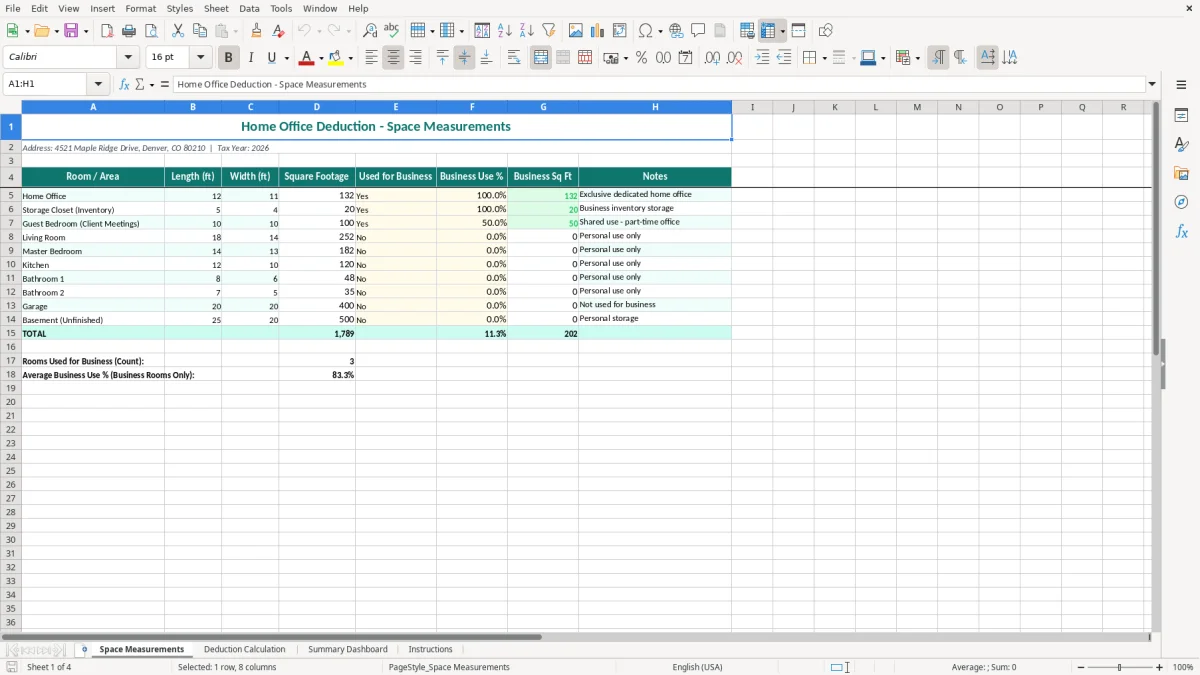
This home office deduction spreadsheet calculates the business-use percentage of your home from room dimensions and business square footage. It includes Space Measurements, Deduction Calculation, Summary Dashboard, and Instructions tabs for organizing a 2026 home-office deduction.
Enter each room's length, width, business-use status, and shared-use percentage on the Space Measurements tab. The workbook separates total square footage from business square footage so you can support the calculation behind your Schedule C deduction.
Use the Deduction Calculation tab to review the result, the Summary Dashboard to see the key figures, and the Instructions tab when you need a reminder about an input or calculation.
A sole proprietor who works from a dedicated room usually needs the calculation when closing the books for the year and preparing Schedule C. A 12-by-11 office measures 132 square feet; in a 1,500-square-foot home, that is 8.8% business use before you consider any other qualifying area.
The Space Measurements tab is useful for a graphic designer, therapist, consultant, or rideshare driver who handles administrative work at home. Image 1 shows the eight columns used to capture dimensions, business status, shared-use percentage, business square footage, and notes rather than storing the numbers in a text document.
An online store with 300 orders a month may use both a workroom and a closet for inventory. A 5-by-4 storage closet adds 20 square feet, but you should identify it separately from an office because inventory storage can have different qualification facts than a general workspace.
The Notes column lets you document why an area is included. For example, write “business inventory storage” for the closet and “exclusive dedicated home office” for a room used only to manage the store.
A general contractor may use a 10-by-10 guest bedroom for client meetings only part of the time. Entering 50% business use produces 50 business square feet, not the full 100, which prevents a shared room from inflating the total.
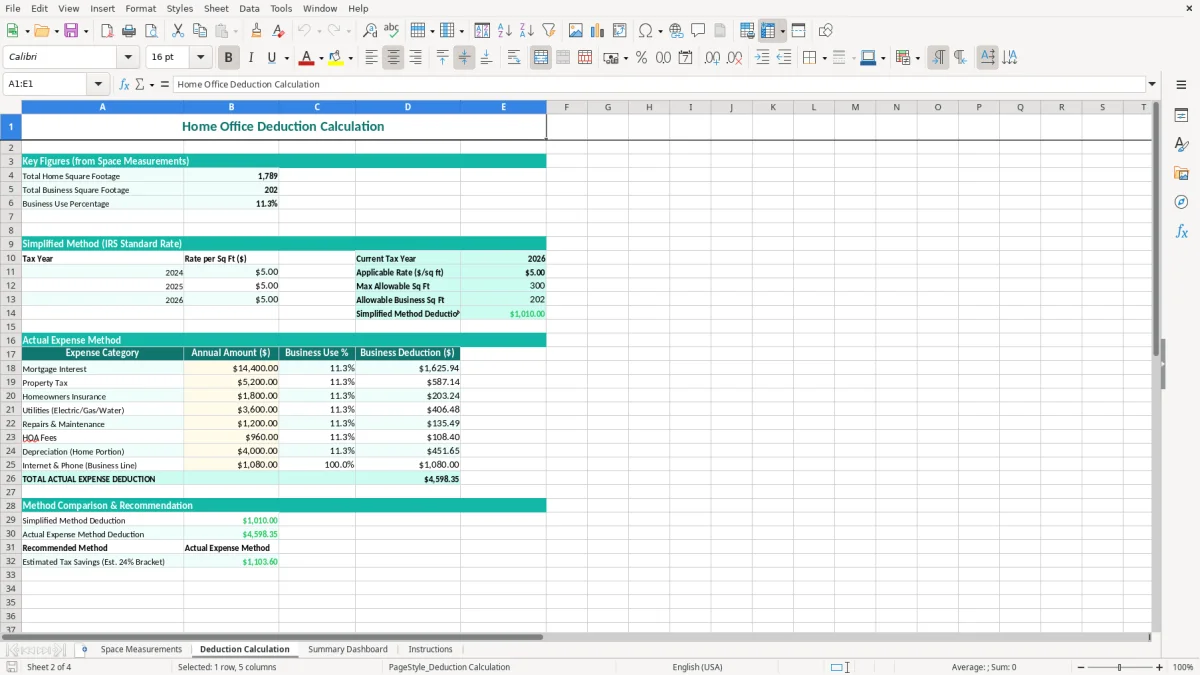
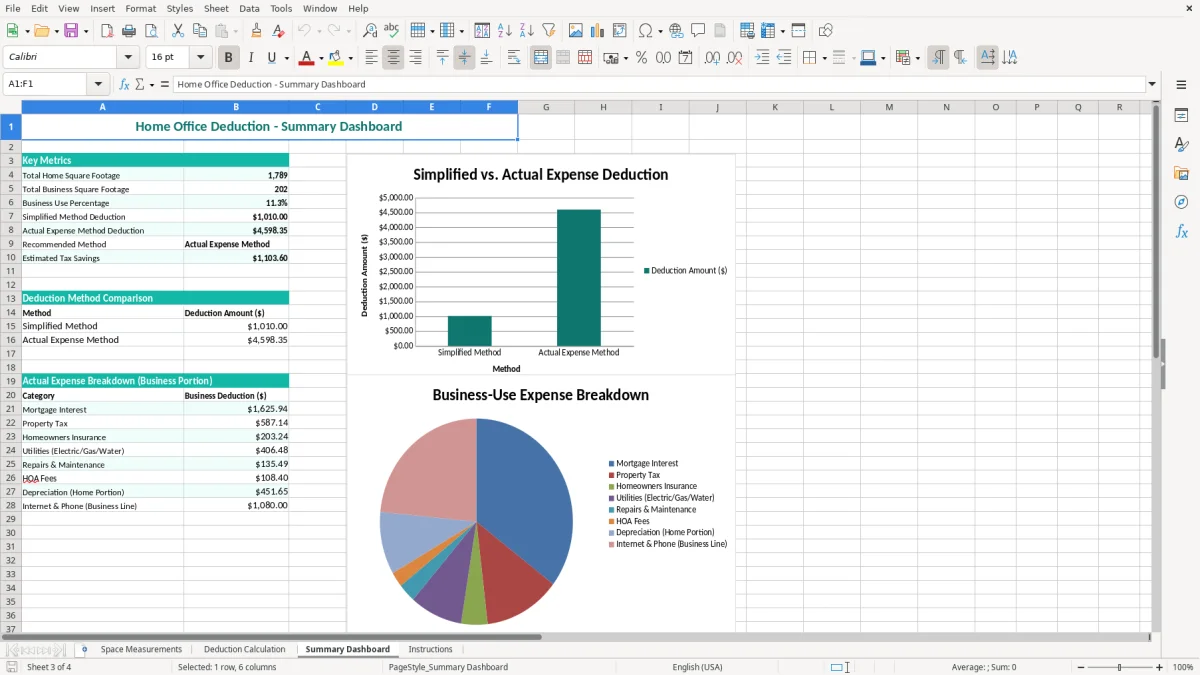
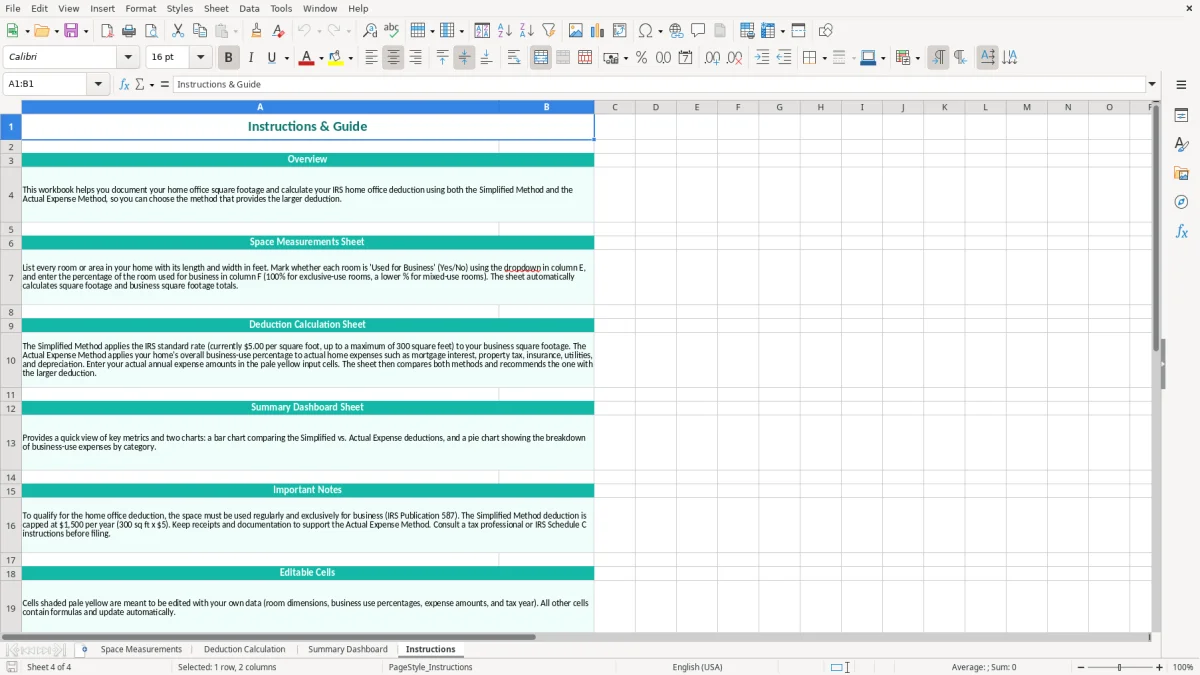
Use the file at year-end, during tax preparation, or after a move or remodel. The Deduction Calculation tab, Summary Dashboard, and Instructions tab shown in images 2, 3, and 4 keep the measurement work connected to the review process without mixing it into your household budget.
For most self-employed taxpayers, the IRS requires the area to be used regularly and exclusively for business, subject to specific exceptions. A desk in a room that doubles as a family TV area generally cannot be treated like a dedicated office simply because the desk is used for work.
For the actual-expense method, the business percentage commonly starts with business square feet divided by total home square feet. If qualifying space is 250 square feet in a 2,000-square-foot home, the allocation is 12.5%; $8,000 of eligible indirect expenses would produce $1,000 before other limits and adjustments.
The simplified method uses $5 per square foot, limited to 300 square feet, for a maximum deduction of $1,500. A 250-square-foot qualifying office would produce $1,250 under that method. The actual method can be better when the home has high rent, mortgage interest, property tax, utilities, insurance, or depreciation, but it requires stronger records.
Use Form 8829 when the actual-expense method applies to a business reported on Schedule C. The deduction generally flows to Schedule C and can affect Schedule SE self-employment tax; it is not a separate personal credit.
Keep the workbook with receipts, utility bills, lease or mortgage records, property-tax documents, and a floor plan or photographs. IRS recordkeeping is generally three years, and records may need to be retained up to seven years in some circumstances.
Do not confuse the home-office calculation with the standard deduction on Form 1040. The standard deduction does not automatically include a Schedule C home-office expense, and an employee working remotely for an employer generally cannot claim the federal home-office deduction as an unreimbursed employee expense.
The most expensive error is often treating a mixed-use room as 100% business space. If a 200-square-foot bedroom is used for work 50% of the time, claiming all 200 square feet instead of 100 can overstate the home percentage by 100 square feet. On a 2,000-square-foot home, that changes the allocation by 5 percentage points.
That difference matters under the actual method. With $12,000 of allocable indirect expenses, a 10% allocation produces $1,200, while a mistaken 15% allocation produces $1,800. The extra $600 is not a harmless rounding issue if the underlying room is plainly shared.
People sometimes measure the exterior of a house, include hallways twice, or write “about 1,800 square feet” without documenting the source. A room-by-room list is easier to reconcile to a floor plan and exposes omissions such as a storage closet used for inventory.
Another frequent problem is entering 12 by 11 but manually typing 130 square feet. The correct product is 132 square feet. Small errors across six rooms can shift the business-use percentage enough to affect the deduction and create needless questions during tax preparation.
A spreadsheet by itself does not prove exclusive and regular use. If you claim a dedicated office, keep a photo, lease or ownership records, and a note describing the business activity performed there. If the business moved rooms during 2026, retain both sets of measurements with the dates.
Finally, do not select the method only because it produces the larger number. The actual method may involve depreciation and future basis consequences, while the simplified method is capped at $1,500. A clean calculation is valuable only when the entries match the facts and supporting records.
Update the workbook when the home layout changes, not every time you pay an electric bill. A practical routine is to review the file during your monthly bookkeeping close and again before the four Form 1040-ES estimated-tax deadlines: April 15, June 15, September 15, and January 15.
Keep one completed workbook for 2026 and avoid overwriting the original measurements. If you convert a 10-by-10 room into a 12-by-11 office, record the new dimensions and the date rather than silently replacing the old evidence.
Image 4's Instructions tab is useful during this review because it stays with the template. Image 3's Summary Dashboard gives you a quick checkpoint before you send figures to your tax preparer or enter them into tax software.
This workbook is a good fit for one home and a manageable number of rooms. If you operate several locations, have multiple owners using different spaces, or need monthly expense allocations across departments, move the source records into QuickBooks or an accounting system and retain the spreadsheet as supporting analysis.
For a simple sole proprietor, a 132-square-foot office and a few annual expense categories do not justify a complicated system. For a growing LLC with three home-based owners and 200 expense transactions a month, controlled accounting software is the better long-term choice.
It calculates room square footage from length and width, applies the Business Use % to shared areas, and shows Business Sq Ft. You can then review the resulting business-use figures on the Deduction Calculation and Summary Dashboard tabs.
The simplified method uses $5 per square foot for up to 300 square feet, creating a maximum deduction of $1,500. A 200-square-foot qualifying office would produce $1,000 under that method.
Enter the room's full dimensions and assign only the qualifying business portion in Business Use %. For a 100-square-foot room used equally for business and personal purposes, 50% produces 50 Business Sq Ft.
No. It organizes and calculates supporting figures, but it does not prepare or file Schedule C or Form 8829. Use the result with your tax software or return preparation process.
Keep a floor plan or measurement notes, photographs where useful, receipts, utility bills, rent or mortgage records, property-tax records, and insurance documents. Retain the workbook with your 2026 tax records; the IRS generally expects records for three years and may require up to seven years in some cases.
Compare both methods. The simplified method is easier and capped at $1,500, while the actual method may produce more when eligible home expenses are high but requires expense records and may involve depreciation and basis considerations.